Positioning vs perception
How to identify your gap
If your intended brand positioning and actual perception don’t match, your marketing and communication will feel harder than it should. No matter how much you do.
You might have a clear idea of how you want your brand to be perceived. What you stand for, how you are different, where you sit in the market, etc.
But if you asked ten people outside your business to describe you, or compare you to your competitors, would they say the same thing?
In most cases, they wouldn’t. And it is in that gap is where your true positioning actually lives.
Your intention vs the actuality
When talking about positioning it is important to talk about perception. The easiest way I can explain the difference is that positioning is the intended perception you want people to have, while perception is how people actually see you. Positioning is something you strategically work to build, and people’s perception is something you cannot control.
So when I in a workshop draw a matrix on the whiteboard and ask you to place where you want to be positioned in the market compared to your competitors, this is the positioning map. But if we then go and ask someone on the street how they would place your brand compared to the alternatives they can think of, this is the perception map.
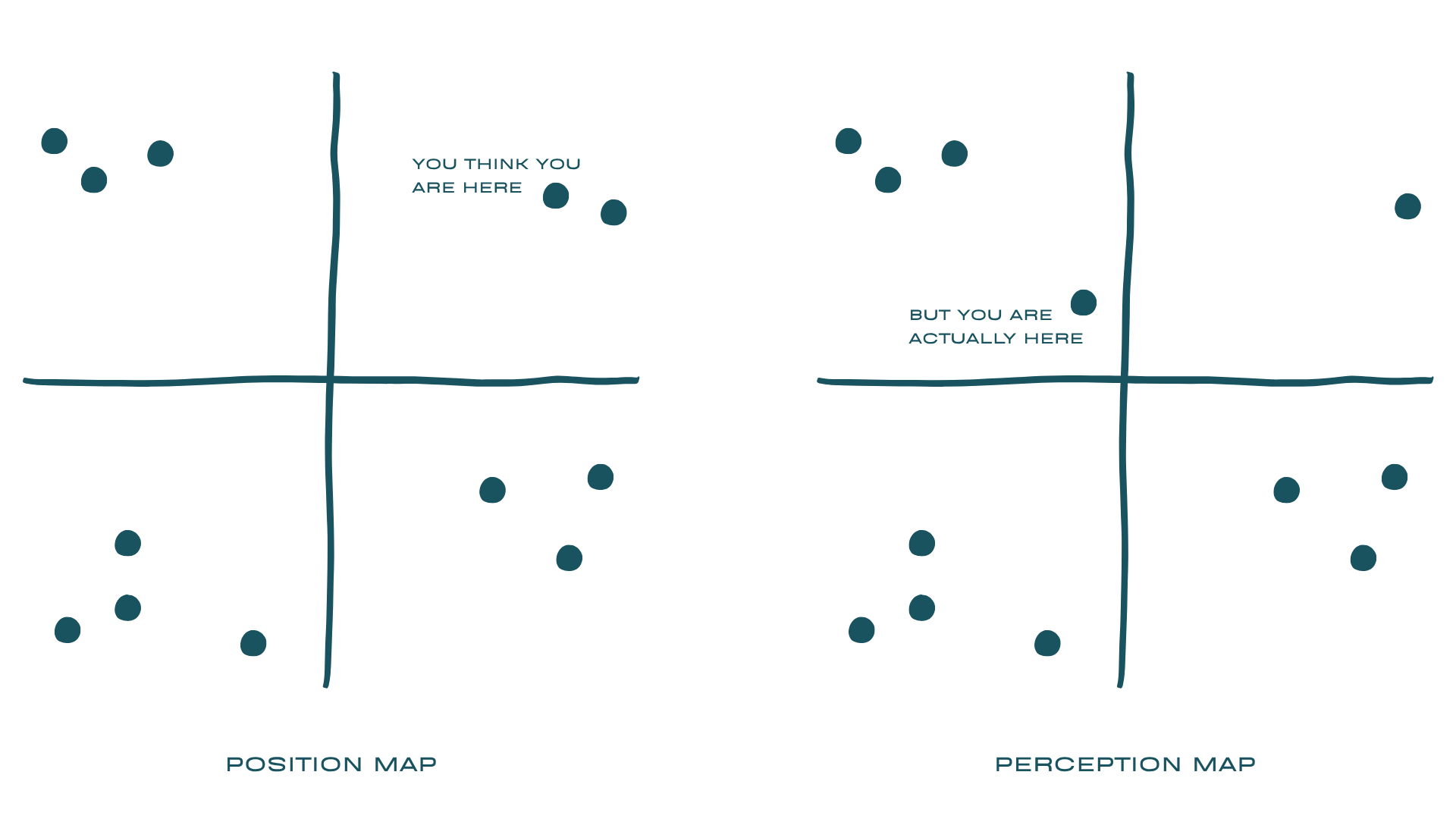
Hopefully you’ll find that people perceive you similarly to how to want to be perceived. Almost never will the two maps won’t align perfectly. This is completely normal. This is because people interpret it through what they already know.
Everyone have their own thoughts, beliefs, experiences, associations and expectations. Whether those beliefs and expectations are accurate or not, these are all things you cannot control. When someone encounters your brand, they are not just seeing the brand. They are filtering, simplifying and placing it into something familiar so it makes senses to them. This is why perception rarely matches the intended position.
At first glance, this can seem confronting. But this gives you something you can actually work with. Real signals of how you’re being perceived and understood in the market.
TIPS:If your’e wanting to try this exercise on your own, spend some time figuring out what you want the axis to represent. Then, simply ask people to place you and your competitors - based on previous experience or knowledge or simply based on first impression.
Examples of the axis can be premium vs affordable, high quality vs low quality, exclusive vs available, aspirational vs relatable, masculine vs feminine, general vs niche, radical vs conservative, direct vs indirect, business customers (B2B) vs end-consumer customers (B2C) etc.
Tendencies tell
If you ask people to place you on the map, you might start to notice some tendencies in their perceptions of you. Maybe you find that a lot of people are placing you in the upper right area. Maybe you see that a majority is placing you somewhere close along the x-axis. These are all valuable information .
A question that needs to be asked however is; does this aligns with what we want? It is a beneficial perception or is it the opposite of what we are wanting to create?
Yes, it aligns? Amazing, keep up the good work!
No? Then this is a signal. It means the way you think you’re showing up, isn’t how you’re actually landing. It means:
The right people might never find you, or overlook you thinking you’re not what they need.
The wrong people might be the only one finding you, and might get frustrated when they realize you’re not what they thought you were.
Your message is working harder than it needs to, and you have to over-explain everything instead of leaving room for fun creativity.
You’re likely compensating with more content, more effort, higher marketing budget, which steals valuable time and energy from other aspects of your business.
Over time, this will create frustration. You’re working sooo hard, but it is not quite clicking. Not because your work isn’t good enough, but because its not clearly positioned in a way that people recognize and chose!
Making sense of the pattern and deciding what can be done to make sure you land where you want to land in peoples mind is the kind of work we would do together in a deep-dive project.
The messy middle
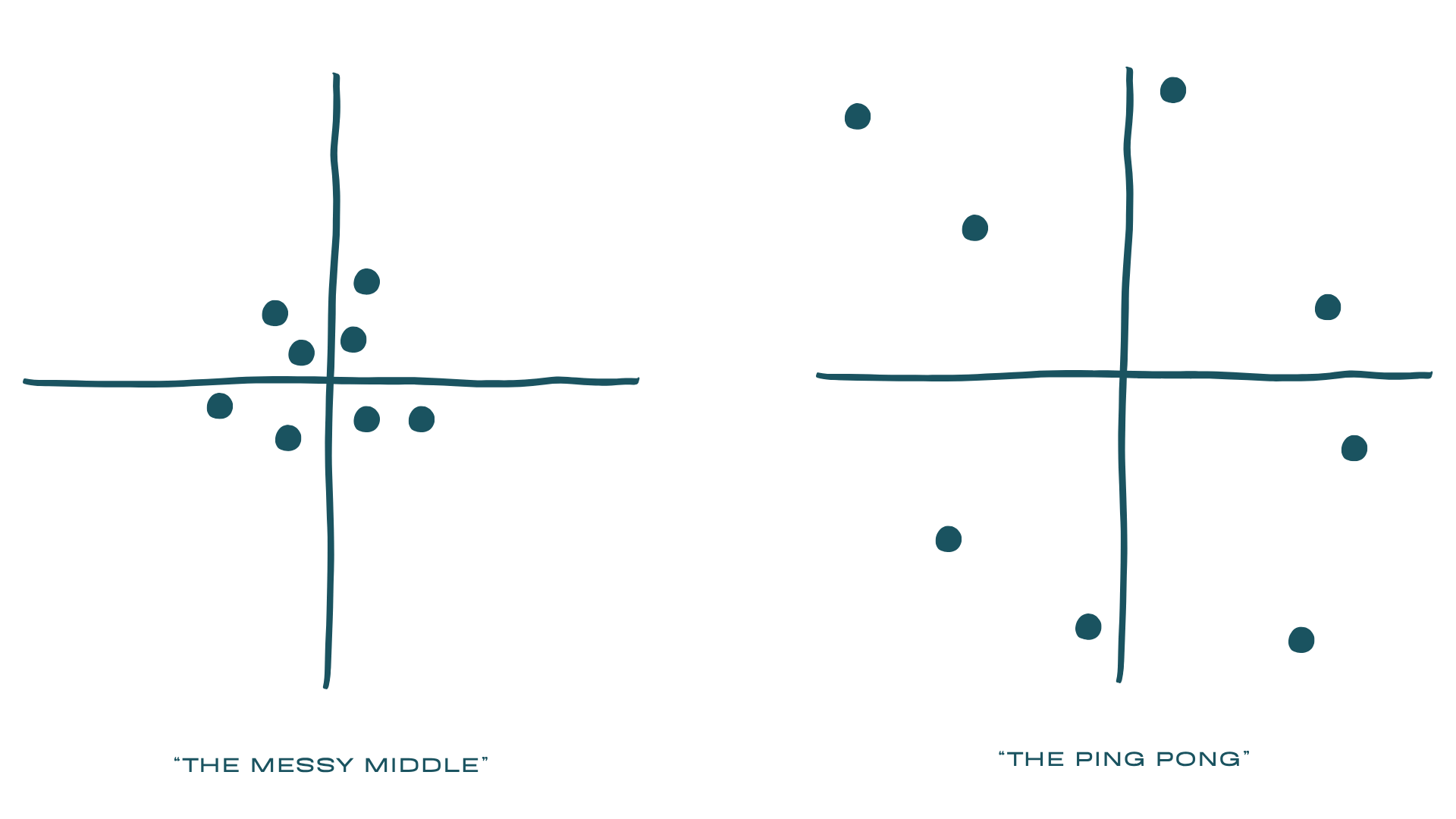
If you’re finding yourself in the middle, you are likely unclear. These are often the brands that feel like they don’t really know what to say or how to make people see the value without losing them 5 minutes in to the explanation.
It’s usually not just lack of clarity in your messaging, but that the position you want to claim is unclear. It’s not about tweaking words. It requires stepping back and getting clear on:
What category you’re actually playing in
What you are competing against, whether you realize it or not
What makes you meaningfully different in that landscape
When this comes through clearly in your messaging, you will likely experience that you don’t have to work so hard to chase people, but that the right people will start coming to you.
This is the kind of work I would do in deep-dive projects focused on positioning and selling points. In these strategic projects we don’t just adjust what you communicate, but clarify where you stand in the first place - so you know how to get out of the messy middle.
The ping-pong pattern
If you ask people to place you on the map and they all place you on wildly different sides of the map, this means your brand is inconsistent. When your brand is experienced in multiple, conflicting ways, the problem usually isn’t creativity or level of activity — it’s direction. Without a clear internal anchor, your communication starts to adapt to everything and everyone. And over time, that makes your brand confusing and harder to understand.
If this is the case for you, having a clear direction and focused mission will help you stay consistent and clear in your messaging. So you can create one strong and lasting impressions instead of two or more.
You need to know:
Who you are, and who you’re not
What value you create, and for whom
What you want to be known for over time, and why
We can build this clarity together in a deep-dive project focused on brand strategy. Not just so you can communicate better, but so you can communicate from somewhere true to you!
The end-goal
The goal isn’t to control perception perfectly, because you can’t. But you can reduce the gap between what you intend and what people actually take away. And when that gap gets smaller, you will notice that something will shift.
Your message becomes easier to understand. Your value becomes easier to recognize. And your brand starts doing more of the work for you. Not because you’re saying more, but because you’re finally being seen more clearly.
Essentially, you can lean back a little and let them come to you 🧡
Are you curious and want to learn more about how to mitigate the perception gap and how positioning applies to you?
